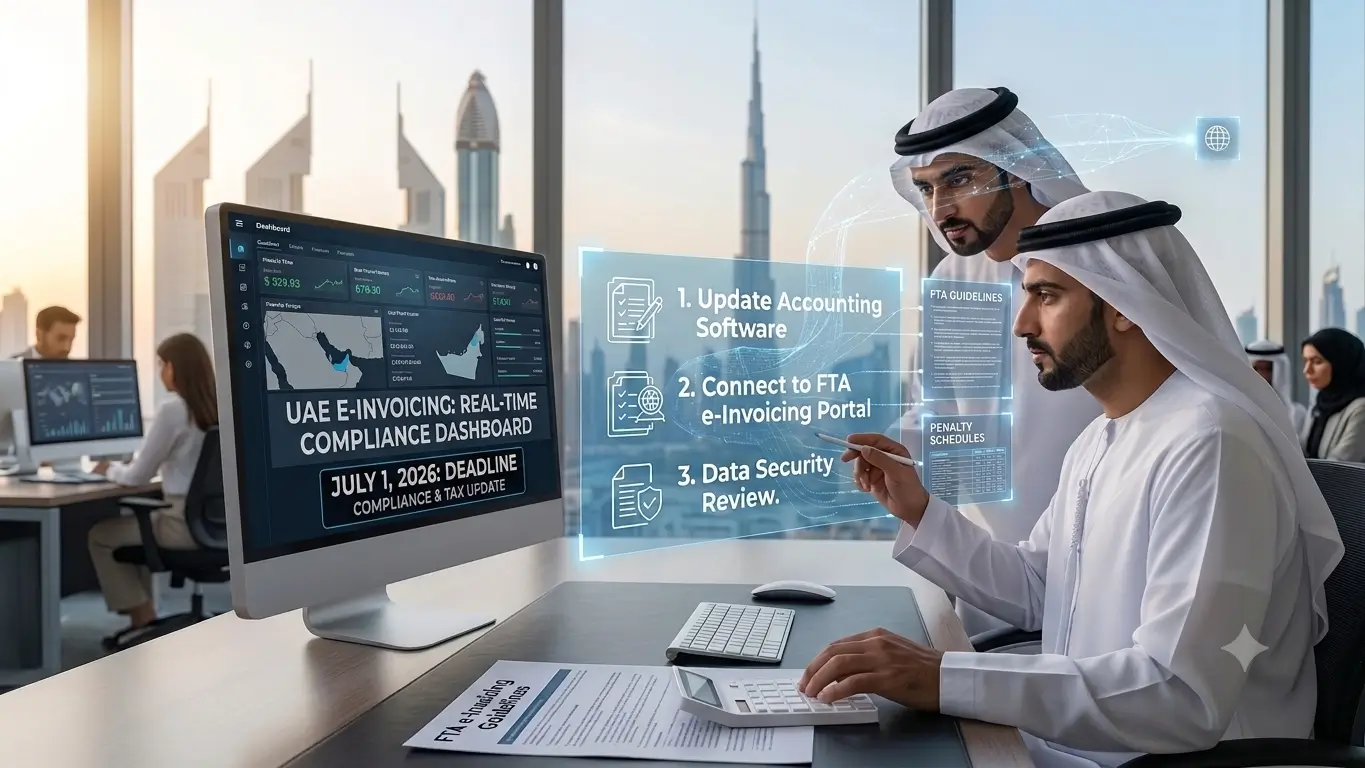
90% of UAE businesses are not ready for e-invoicing. And the clock just ran out. The UAE’s mandatory electronic invoicing system launches its pilot phase on July 1, 2026 — that’s weeks away. If your business hasn’t selected an accredited service provider yet, you’re already late. And the fines for getting this wrong start at AED 5,000 per month.
This post breaks down exactly what e-invoicing means for your business, who it applies to, what you need to do right now, and what happens if you don’t.
What Is UAE E-Invoicing — and Why Is It Happening Now?
Think of e-invoicing as the UAE government replacing your standard invoices — whether paper or PDF — with structured, machine-readable digital documents that connect directly to the Federal Tax Authority (FTA) in real time.
It’s not a new idea. Saudi Arabia already processed over 8.2 billion e-invoices in 2025 alone. The EU has had it for years. The UAE is now catching up — and doing it fast.
The UAE processed 139.55 million payments worth more than AED 25.9 trillion through its financial systems in 2025. Most of those transactions were still tied to manual invoicing. That’s the problem the FTA is solving: more transparency, less fraud, faster tax audits, and better compliance tracking.
For business owners, the key thing to understand is this: e-invoicing isn’t a software upgrade you can do later. It’s a compliance obligation with real penalties attached.
Who Does This Apply To?
The rollout is phased, based on your annual revenue:
Phase 1 — Large Businesses (Revenue AED 50 million or more):
- Select an accredited service provider (ASP): by July 31, 2026
- Full e-invoicing system live: by January 1, 2027
Phase 2 — Smaller Businesses (Revenue below AED 50 million):
- Select an accredited service provider: by March 31, 2027
- Full compliance: by July 1, 2027
Phase 3 — Government Entities:
- Select an accredited service provider: by March 31, 2027
- Full implementation: by October 1, 2027
The July 1, 2026 pilot phase applies to a selected group of businesses chosen by the Ministry of Finance. But every business needs to be in preparation mode right now — regardless of which phase you fall into.
What Exactly Is an Accredited Service Provider (ASP)?
An ASP is essentially the bridge between your business and the FTA. Instead of sending invoices directly to the government, you issue them through your company systems, your ASP validates them, and they’re transmitted to the FTA automatically.
The FTA has approved 28 ASPs as of mid-2026. These are software and technology companies certified to handle invoice validation and government system integration.
Your job is to pick one, integrate their system with your accounting software, and ensure your invoices go through that pipeline from the mandatory implementation date.
If you’re already using accounting software like Zoho Books, QuickBooks, or SAP, your existing provider may already have an ASP integration available. Check with them first.
What Transactions Are Covered?
The initial rollout covers:
- Business-to-Business (B2B) transactions
- Business-to-Government (B2G) transactions
Consumer-facing (B2C) transactions will be addressed in later phases. The system uses what’s called the Decentralised Continuous Transaction Control and Exchange (DCTCE) model — a 5-corner model where invoices flow through accredited intermediaries rather than being submitted directly to the government. This is the same model used in several European and Gulf countries.
The Penalties for Non-Compliance
This is where business owners need to pay close attention. Cabinet Resolution No. 106 of 2025 sets out the penalty structure:
- Failing to appoint an ASP on time: AED 5,000 per month
- Failing to implement the system on time: AED 5,000 per month
- Each missing or delayed electronic invoice: AED 100, capped at AED 5,000 per month
If you’re a large business and you miss the July 31 ASP appointment deadline, you’re looking at AED 5,000 a month in fines before you’ve even started the implementation phase.
One silver lining: businesses that voluntarily adopt the system early are exempt from penalties until their mandatory implementation date kicks in.
What Your Business Should Do Right Now
Whether your deadline is July 2026 or mid-2027, the smart move is to start now. Here’s a practical action plan:
Step 1 — Assess your current invoicing setup. How are you generating invoices today? Manually in Excel? Through accounting software? Through an ERP system? You need to know your starting point before you can map out the transition.
Step 2 — Identify which phase applies to you. Calculate your annual revenue. If you’re above AED 50 million, the July 31 ASP deadline is live. If you’re below, you have until March 2027 — but waiting that long is a risk given the complexity involved.
Step 3 — Review the FTA’s approved ASP list. There are 28 options. Evaluate them on integration capability with your existing systems, pricing, and support quality.
Step 4 — Conduct a gap analysis. Understand what your current accounting system can and can’t do in relation to e-invoicing requirements. This is where most businesses underestimate the workload.
Step 5 — Train your finance and operations team. E-invoicing changes how your accounts receivable and payable teams work. Budget for training time, not just software setup.
Step 6 — Don’t wait for perfection. Industry estimates suggest 90% of UAE businesses haven’t started this process yet. Those who move now will get better attention from ASPs, avoid implementation bottlenecks, and face significantly less deadline pressure.
What If You’re Setting Up a New Business in the UAE Right Now?
If you’re in the process of setting up a company in Dubai or anywhere in the UAE, e-invoicing compliance should be part of your setup checklist from day one.
Getting your VAT registration, corporate tax registration, and accounting infrastructure aligned with e-invoicing requirements before you start trading is far simpler than retrofitting them later.
At Eagle Wings, we’ve been guiding businesses through UAE compliance requirements since 2011 — and we’re already helping our clients navigate the e-invoicing transition as part of their overall compliance strategy. We regularly see new businesses underestimate the setup complexity involved, which is why we recommend addressing it early.
Frequently Asked Questions
Is e-invoicing mandatory for all UAE businesses?
Yes, eventually — but on a phased timeline. Businesses with annual revenues above AED 50 million must comply from January 1, 2027. Businesses below that threshold must comply from July 1, 2027. The requirement covers B2B and B2G transactions in the first phase.
What is an Accredited Service Provider and do I need one immediately?
An ASP is an FTA-certified technology company that handles invoice validation and transmission to the government. If your revenue exceeds AED 50 million, you must appoint one by July 31, 2026. Smaller businesses must appoint one by March 31, 2027.
What happens if I miss the e-invoicing deadline?
Penalties under Cabinet Resolution No. 106 of 2025 include AED 5,000 per month for failing to appoint an ASP or implement the system on time, plus AED 100 per missing electronic invoice, capped at AED 5,000 per month.
Does e-invoicing replace VAT invoices?
E-invoicing doesn’t replace your VAT obligations — it changes how you issue and report invoices. Your e-invoices will need to contain all required VAT information in a structured digital format validated by your ASP.
Can I use my existing accounting software for e-invoicing?
Possibly. Check if your current software provider (e.g., QuickBooks, Zoho, Xero, SAP) has an integration with one of the 28 FTA-approved ASPs. Many providers are already building or have built these integrations.
Don’t Let a Compliance Deadline Catch You Off Guard
UAE e-invoicing is the most significant change to how businesses manage transactions and tax reporting in years. The July 1 pilot is the starting gun — not the finish line.
Whether you’re a large corporation already in Phase 1 or a growing SME with a 2027 deadline, the preparation work is the same. The only difference is how much pressure you’ll be under when you do it.
Eagle Wings has been helping businesses stay compliant and competitive in the UAE since 2011. If you need guidance on e-invoicing readiness, VAT registration, or corporate tax compliance, our team is ready to help.
Book a free consultation today and get a clear, practical roadmap for your business compliance in 24 hours.